


Sacramento City College Students Turn Milk into Quesillo
with the Department of Food Science and Technology at UC Davis
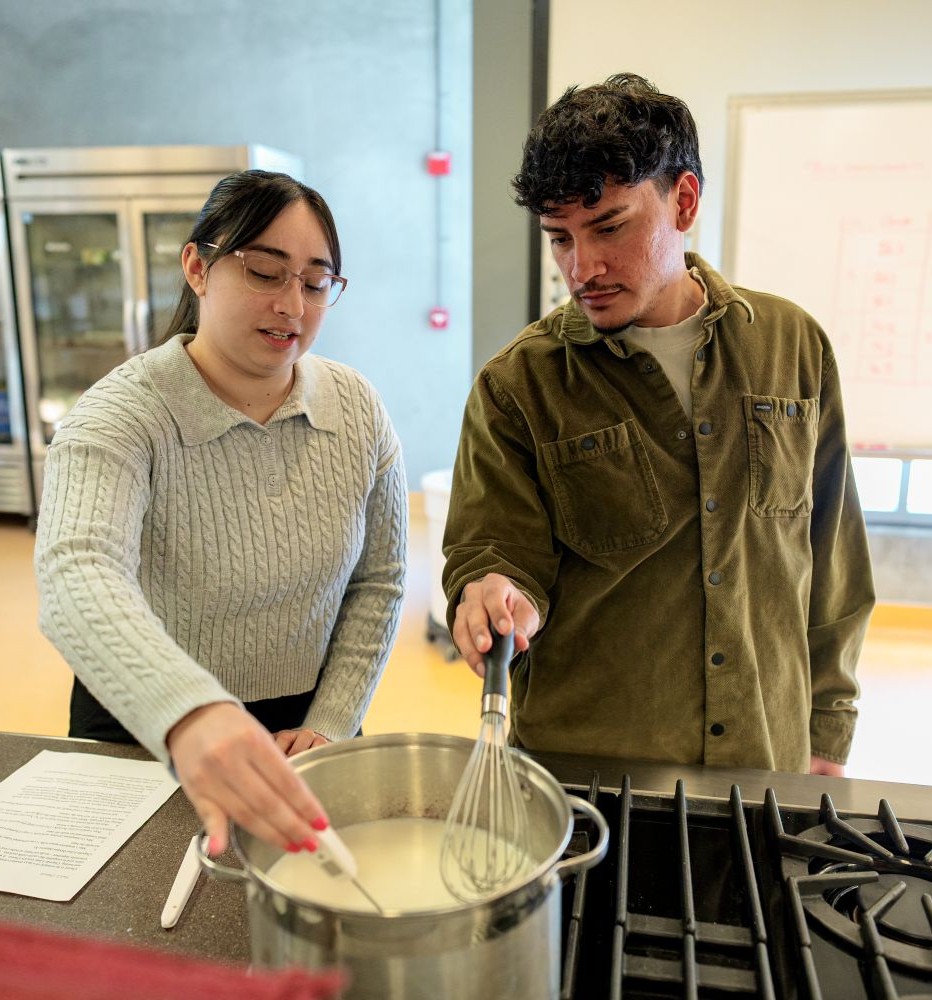
Teams of students stood at their cooking stations at the Robert Mondavi Institute for Wine and Food Science, pots and thermometers in front of them, most about to make cheese for the very first time.
Sacramento City College Instructor, Jessica Coppola acknowledged the nerves that come with walking into a new space and told everyone to settle in. Then she got straight to it, “I think we just jump in.”

A Field Trip With Purpose
Most of the participants were Sacramento City College students. Some are majoring in nutrition or food science, and others are from Coppola’s beer-brewing class. This visit connected community college students with UC Davis resources by combining a hands-on cooking session with time to talk to people already on the path they may be considering.
The day centered on the Food Innovation Lab, one of several spaces in the Department of Food Science and Technology at the Robert Mondavi Institute complex. The group also toured the California Processing Tomato Industry Pilot Plant, where food science students get hands-on food processing experience, and the Anheuser-Busch InBev Brewery, home to UC Davis’ brewing program.
Jasmine, a nutrition major here at UC Davis, explained how her department splits into two tracks. Clinical nutrition prepares students to become registered dietitians while Nutrition Science places more emphasis on biochemistry and physiology. Both majors share the same core nutrition courses.

From Milk to Oaxaca Cheese
The teams made Oaxaca-style cheese, known in its home state of Oaxaca, Mexico, as quesillo. Like mozzarella, it is a stretched-curd cheese, made from the same ingredients: milk, an acid, and rennet. What sets it apart is the shaping. The warm curd is pulled into long ribbons and traditionally wound up like a ball of yarn, which is why it pulls apart into strings and melts so well in quesadillas.
Food Innovation Lab Manager Matt Ford explained that the milk itself shapes the result. Fat is what gives fresh cheese its richness, so higher-fat milk makes a creamier cheese, and lower-fat milk makes a leaner, firmer one.
The acid lowers the milk’s pH, and the rennet, an enzyme, causes the milk proteins to bind together into a soft curd. After the teams took their milk off the heat and stirred in the rennet, there was nothing to do but wait for the milk to split into solid curds and liquid whey. “The waiting is hard,” one student admitted.
When it happened, the reactions were immediate. “We’ve got scrambled eggs!” one team excitedly announced as their curds formed.
The drained curds went into the microwave in short bursts, which heated them until they could be kneaded and pulled into long, stringy ropes. After the microwave step, students worked salt and lemon pepper into the warm cheese by hand.
What the Teams Learned Along the Way
Measure the cheese, not the liquid. As teams heated their milk to 43C, they noticed their thermometers read higher in the whey than in the curds. The liquid whey heats quickly, while the dense curds warm more slowly, so you want to measure the temperature of the cheese, not the liquid.
Don’t overdo the microwave. The curds have to get hot before they will stretch, but too much heat damages the proteins. Overheated curds turn rubbery and plastic-textured instead of soft and elastic, so short bursts with kneading in between work best.
Acids can be swapped, carefully. One team reached for lime juice instead of citric acid. Citrus juice is acidic too, so their milk still separated into curds and whey.
Everyone Went Home with Cheese
Despite a few thermometer troubles and one improvised acid, every team ended the session with their own cheese. For students weighing careers in nutrition, food science, or brewing, the visit offered a taste of what studying food at UC Davis looks like, with hands in curds, eyes on thermometers, and plenty of questions along the way.
The Robert Mondavi Institute's mission is to enhance public understanding of wine, brewing, and food sciences, and events like this carry that mission beyond campus to the next generation.
Curious about studying food science, nutrition, or brewing at UC Davis? Visit the Department of Food Science and Technology website. If you’re interested in bringing a group to the Robert Mondavi Institute, visit rmi.ucdavis.edu to explore upcoming events, schedule a tour and more.
Kaylianne Jordan is a viticulture and enology graduate at UC Davis pursuing her master's degree. She has a background in culinary arts and a passion for sustainable farming and enjoys exploring the connections between agriculture, winemaking, and community. Outside of college, she loves trying out new recipes, and discovering local food spots.