


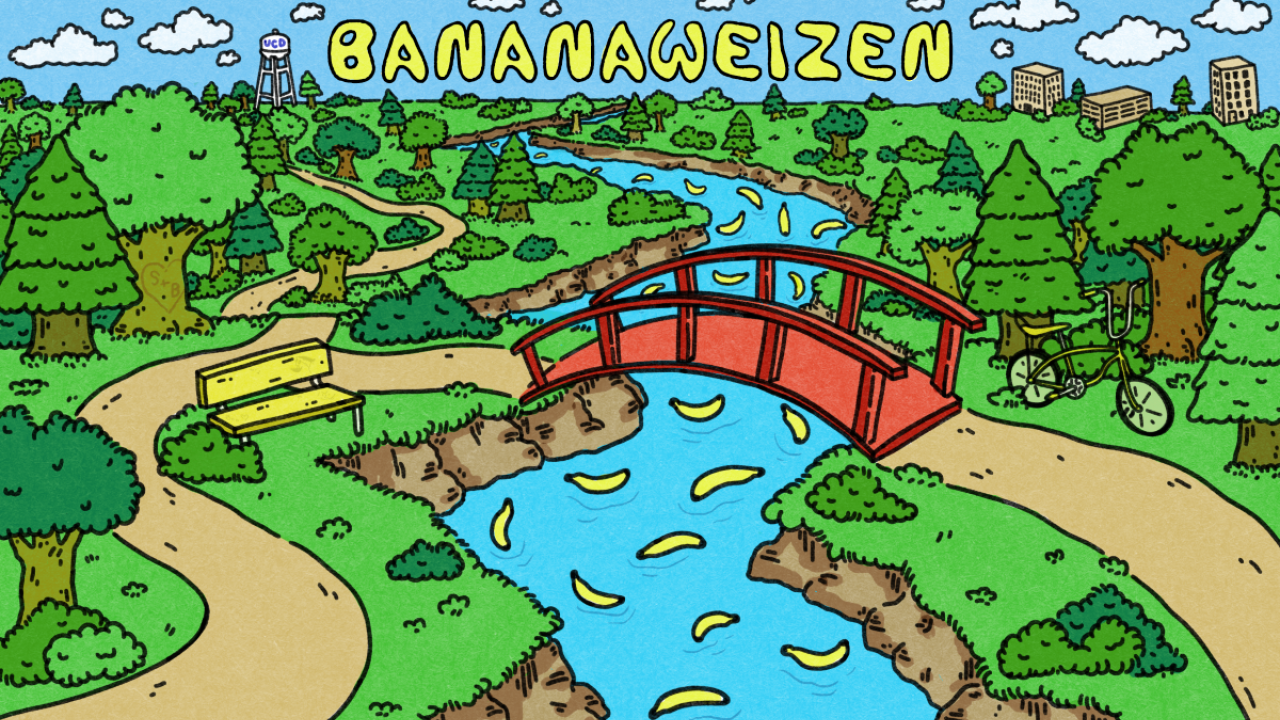
Bananaweizen: The Beer Behind the 2026 Iron Brew Win
Iron Brew is one of those UC Davis traditions that sounds almost too good to be real. Every winter, students in FST 102B Practical Malting and Brewing spend weeks formulating recipes, brewing batches on nanobreweries in the RMI pilot brewery, and competing for the chance to have their beer produced commercially.
Past winners, including Off the Clock, Caledonian Nights, Mighty Gale Ale, and Brew La-La have gone from campus fermentors to taps at The Gunrock, Sudwerk Brewing Co., and now Dunloe Brewing .
This year, that beer happens to be my team’s Bananaweizen.
Bananaweizen is a Hefeweizen, hazy gold with a pillowy white head. On the nose, isoamyl acetate from the yeast drives a generous banana aroma with subtle clove and warm spice layered beneath. The palate is soft and round with restrained bitterness from the hops we used.
It's the kind of beer that's as fun to drink as it was to brew, which, for the record, was extremely fun.
The Team, the Beer, and the Secret Weapon

Our team came together the way many things at Davis do, through the College of Agricultural and Environmental Sciences and a shared willingness to figure it out. Christopher Chiu (food science & technology, brewing sciences concentration), Amber DePry (viticulture & enology), Humberto Gonzalez Loera (viticulture & enology, M.S.), and I spent the quarter debating fermentation science until something excellent came out the other side.
Chris was our secret weapon. With hands-on experience in UC Davis's own campus brewery, he arrived at brew day knowing the equipment, the process, and the order of operations. The three of us viticulture and enology students arrived with genuine enthusiasm, a solid grasp of what yeast does at a biochemical level, and a willingness to take direction.
What followed was three mash steps, including a protein rest at 44°C to improve the foam, a rest at 63°C to allow enzymes to convert grain starches into fermentable sugars, and a mash out at 72°C to lock in the sugar profile. After nine days of fermentation and a CO₂ blow-off to remove some lingering sulfur, we had the banana aroma we were hoping for in our glasses.
The Judging
Iron Brew uses a panel of industry judges from around the Davis area, including Trent Yackzan, co-owner of Sudwerk Brewing, Brennan Fleming of Dunloe Brewing, Chris Moran of Fieldwork Brewing, Teresa Psuty of Crooked Lane Brewing in Auburn, and several other local brewers and certified judges.
The judges were generous with their honesty. The sulfur that had worried us during fermentation showed up in some judges’ notes, and a few flagged the banana as more muted than the name promised. We won with a beer that had room to improve, but the style, concept, and execution were strong enough to pull out the win by less than a single point.
Brewing at Dunloe: From Pilot Batch to 16 Barrels
This year's Iron Brew winner found a home at Dunloe Brewing, right here in Davis, and the partnership felt like a natural fit from the first email.

Dunloe was founded by Brennan Fleming, a UC Davis alumnus who spent several years at Sudwerk before going independent. He worked his way up from cleaning kegs to running the copper brewery, the cellar, and the barrel program while finishing a bachelor's in food science and the Master Brewers Program. He left in 2016 to build the Olive Drive location himself and opened Dunloe in July 2017.
Scaling a recipe from a pilot batch to 16 barrels is not trivial. Before brew day, Brennan reviewed our recipe and helped us adjust it to fit his system, such as reducing the proportion of wheat malt. We also added ALDC and Clarex to the recipe. ALDC to prevent diacetyl formation during fermentation, and Clarex for haze reduction. These were small decisions with real impact at commercial scale.
On brew day, all four of us were there. We took turns pouring bags of grain into the RMS roller mill and watched our recipe move through the mash tun, into the kettle, and through the heat exchanger.
Spending a full day working alongside Brennan, seeing how a brewhouse actually operates, and watching our beer take shape at a scale we'd never worked at before was genuinely one of the coolest experiences of my time at Davis.
The Label
The artwork on every can of Bananaweizen was created by a local artist through Dunloe's drawing club. Brennan's idea from the start was to submit a written concept and name as a prompt, have the club execute it, and compensate the artist, keeping the beer connected to the community it's being made for and supporting a local creative in the process. It's a small decision that says a lot about how Dunloe operates.
What Dunloe Is Really About
Brennan talked about diversity in brewing the way a chef might talk about cooking: “more cultures at the table makes the food more interesting”. That philosophy shows up everywhere at Dunloe, from hosting Gorilla Queer Bar events and drag shows, to brewing the "Black is Beautiful" beer in solidarity with the Michael J. Douglas Foundation, to collaborations with Oak Park Brewing built on shared values and genuine friendship. The Olive Drive location has regulars who come every Thursday to play cards and the brewery dog, Arrow, will let everyone know when you've arrived.
Find It While You Can
Bananaweizen started as a class assignment and productive arguments that apparently produce excellent Hefeweizens.
Watching our beer move from a campus fermentor to a real collaboration with a Davis brewery that stepped up for this tradition and cared enough to do it right has been one of the highlights of my time at UC Davis.
If you're in Davis, you can find our Bananaweizen on tap at Sudwerk, the Gunrock, and Dunloe’s The Local until it’s gone. It's hazy, it's golden, it smells like banana, and there's a small but very proud team of UC Davis College of Agricultural and Environmental Sciences students behind every can.

Kaylianne Jordan is a senior studying Viticulture and Enology at UC Davis. She has a background in culinary arts and a passion for sustainable farming and enjoys exploring the connections between agriculture, winemaking, and community. Outside of college, she loves trying out new recipes, and discovering local food spots.